Covid-19 is a massive nob. It has changed the world in near record time, and mostly shown us how embarrassing people can be. Anyway, I decided that I'd do something different to amuse myself with all this alone time which we're all going to have to get used to. For the first time in many years, I decided to have a crack at the Middle Earth model range. They're a very different style of model to what I usually do, and thus a bit of a different challenge. I decided to start with the Army of the Dead.
These are interesting models because... well... they're ghosts. You want them to look ethereal and otherworldly, which means a much narrower colour palate. That being said, you don't just want to have a block of white. Trust me, I've seen it and it... wasn't pleasant.
There's always a temptation in these cases to just apply a white undercoat and then slap a wash over the top. Everyone has at some point thought that this is an easy way to produce etheral effects. If you haven't tried, don't. It's not quite that simple.
The first step was in fact a white undercoat. After that, I basecoated the models in Grey Seer. Any cold bluish off-white would do the trick. Next, I mixed Nuln Oil with acrylic medium about 50/50 (to stop pooling). The trick here is that you want the shadows and textures to show up. You'll do better with a black wash that going straight to a coloured tint.
Once the black wash was dry, I thinned down some Nighthaunt Gloom. This is a paint which I was totally befuddled by when I first tried it, but I don't think I really grasped it properly. You really have to dilute it for it to work this way. I'm talking maybe 20/80 with medium. After that, I applied it all over the models. The key here is that it has to be very thin, thin enough that none of the details will be lost. Nighthaunt Gloom isn't a wash even though it looks like one. It's more akin to a contrast paint.
Anyway, when that was dry, I gave the models a good hearty drybrush with Grey Seer to pick up the highlights and add some extra contrast.
For the base, I decided I needed a sharp contrast, but one that made sense in the Middle Earth setting (my daemon world bases wouldn't make a lot of sense). I did the standard basing technique: PVA glue some sand to the base and then paint dark brown. There I followed with a light brown drybrush, and finally a cream drybrush. I used some withered yellowish static grass from War World Scenics. Last of all, I decided that there should be some snow. Now, I know that in LOTR we never see the Dead of Dunharrow in snow, but I figure that when not helping Aragorn to ruin Sauron's day they probably haunt desolate and harsh places. I used Citadel's 'Valhallan Blizzard' to create the snow effects. Trust me, this stuff is so much better than any snow flock you've ever used. The frozen pools you can see were achieved with crackle paint, layered over with white and then with thin coat of Nihilakh Oxide.
So there we have it! Twenty models done in a few hours. Next up and much more difficult... some Rohirrim.
Wednesday, 18 March 2020
Thursday, 12 March 2020
The trees STILL have an attitude problem
I've always had this feeling that trees should look like... well... trees. In most cases, I prefer some nicely based Gaugemaster trees. However, for reasons I honestly don't quite recall I have a couple of Citadel Woods in my bitz box. I decided that it was time to make an evil wood. I was inspired by two pieces of lore from the old Realm of Chaos tomes - if you haven't got these, try to get hold of a copy. They're the most Chaosy thing that ever Chaosed. Anyhow, the passages in question are the descriptions of the 'Tree of Damned Shades' and the unwholesome forest around 'The Marcher Fortress'. I decided to make some nasty trees that can either be used as spooky terrain or as Feculent Gnarlmaws.
The two trees I started working on were pretty different. One was almost intact whereas the other had been rudely sawn off halfway as part of my Coeddil conversion. This meant that one of them would be traditionally... uh... treeish, whilst the other might take a bit more thought.
With the more complete one, the first thing I had to do was to put some visibly and identifiable Nurgle bits on it. I find that if you add a couple of very recognizable bits to a piece, it chases the mood of the model to fit the theme. In this case, I used symbol Nurgle glyphs, some of the rotten heads from the Plaguebearers sprue, some bells and a Plaguebearer head. I also added a spare Kharibdyss head for extra creep value. You'll notice that some of the ends of branches have been replaced with bits from the Rotigus staff but the Great Unclean One sprue.
I had a special idea for the other one, give its shape. I added a Nurgle glyph to one side, but the main event here was the addition of a Maggoth mouth to the end to give it the feel of a carnivorous plant crossed with an angry dune worm.
Finally, I added some more ghoulish bits. The larger tree has a zombie hand groping from the end of a branch, and I glued Woodland Scenics lichen onto both to be the flesh vines.
The trees are mounted onto 3mm MDF bases to give them an extra bit of bulk. And there we have it. More evil trees for a display or game board!
Labels:
Chaos,
Conversion,
Feculent Gnarlmaw,
Nurgle,
Warhammer 40k
Wednesday, 11 March 2020
More manky death goats
The Blood Bowl Pestigor looks like a fish.
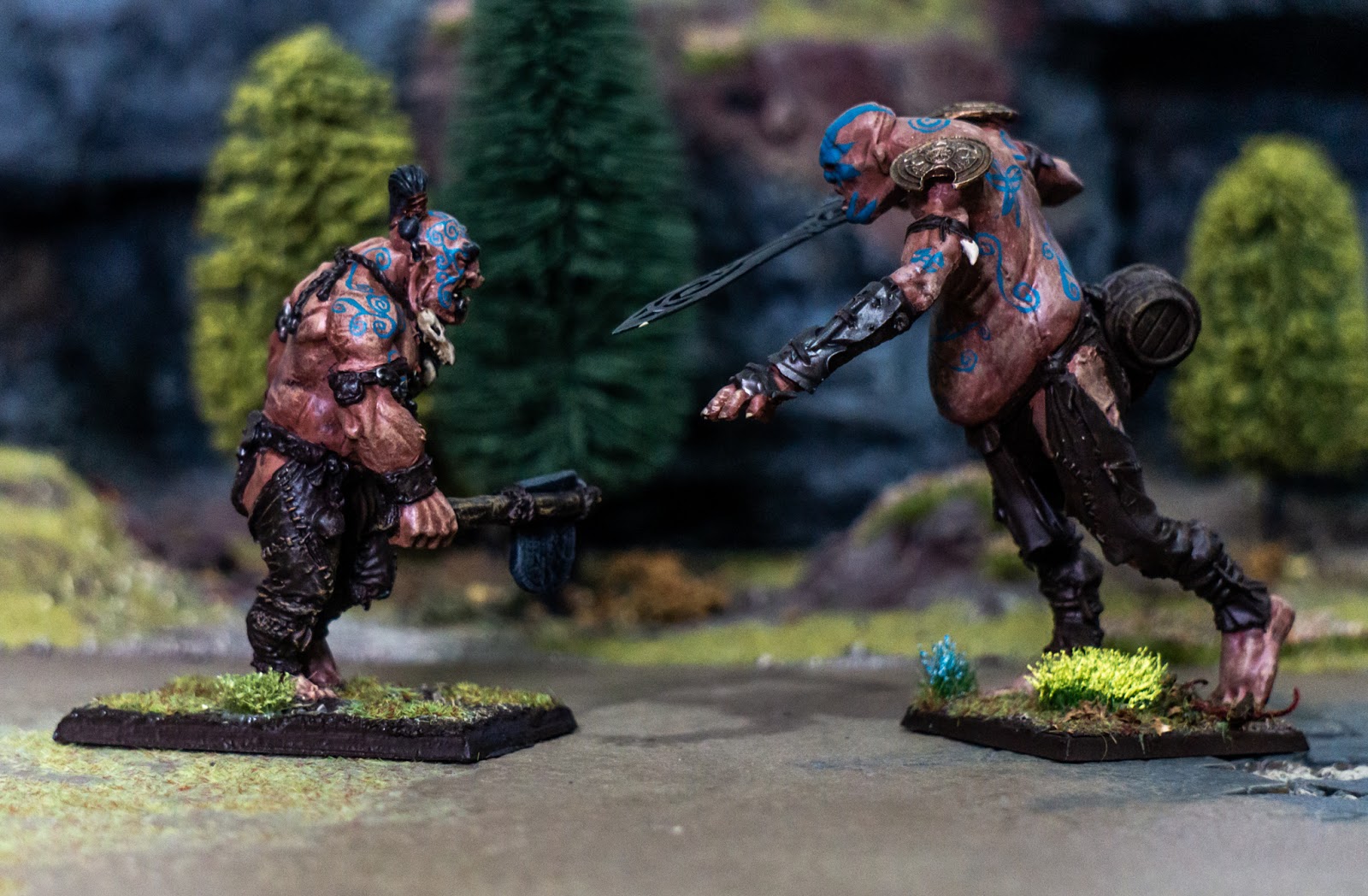
This really saddens me. I think I know what they were going for, but it doesn't work for me.What does work for me are Pestigor, as readers may recall. Seeing as GW and I seemingly differ on what the galaxy's most unhealthy murder-goats should look like, I decided it was time to makesome new ones.
Both of these beautiful specimens are based around the bodies of Plaguebearers. They have the right bloated and sickly appearance whilst being more or less the right size and shape. First of all, I clipped the legs off and plained down the stumps.
Next, I cut the legs off of some spare Gors (my WFB Beastmen army has about 400 Gors, a fact I still can't actually explain and find faintly embarrassing, the point being that I can spare a few bodies). The legs had to be pinned onto the sides of the Plaguebearer bodies because the join will be both too difficult and too fragile otherwise. I then filled in the gaps with my usual PVA/tissue solution followed by green stuff.
The arms were easy to sort out. In one case I literally just lifted some Plaguebearer arms and repositioned the sword-arm. With the other one, I used a spare Gor arm. The burst pustule wossnames were just drilled in with a fine drill bit.
Sorry about the Gor arse. But it had to be done.
Anyway, that's another two added to the horde!
This really saddens me. I think I know what they were going for, but it doesn't work for me.What does work for me are Pestigor, as readers may recall. Seeing as GW and I seemingly differ on what the galaxy's most unhealthy murder-goats should look like, I decided it was time to makesome new ones.
Both of these beautiful specimens are based around the bodies of Plaguebearers. They have the right bloated and sickly appearance whilst being more or less the right size and shape. First of all, I clipped the legs off and plained down the stumps.
Next, I cut the legs off of some spare Gors (my WFB Beastmen army has about 400 Gors, a fact I still can't actually explain and find faintly embarrassing, the point being that I can spare a few bodies). The legs had to be pinned onto the sides of the Plaguebearer bodies because the join will be both too difficult and too fragile otherwise. I then filled in the gaps with my usual PVA/tissue solution followed by green stuff.
The arms were easy to sort out. In one case I literally just lifted some Plaguebearer arms and repositioned the sword-arm. With the other one, I used a spare Gor arm. The burst pustule wossnames were just drilled in with a fine drill bit.
The heads are Gor heads, but they mainly looked like massive angry goats rather than creepy diseased creatures. So I filed off those big glowering eyebrows and replaced them with the eyepieces from the Marauder Horseman champion's horse. Getting these off the original component is NOT easy: you have to cut the eyepiece away with damaging it or taking too much of the horse's head. There's a nasty cut on my thumb to attest that it's a bit of a slog!
It's also worth noting that the Plaguebearer models have massive great necks. I needed to prune them back, pinned the head to the necks and then fill the gaps.
Once I'd painted them, there were some issues even with the filling, specifically around the leg joins. So I decided to hide the problem by bulking out the fur with black static grass.
Anyway, that's another two added to the horde!
Labels:
Beastmen,
Chaos,
Conversion,
Death Guard,
Nurgle,
Pestigor,
Warhammer 40k
Tuesday, 3 March 2020
Tall dudes
A question which almost nobody is asking but which I'm going to have a crack at answering anyway is: which giant is better? The metal 6th edition Orcs and Goblins giant or the 2006 multipart plastic kit?
As you can see, I've got both as part of my eternal Albion army project. If the Age of Rebuilding has achieved nothing else, it has made me a master of the Ebay watch list, and these two both come up at reasonable prices. I like them both, but let's compare them.
Size
As you can see, I've got both as part of my eternal Albion army project. If the Age of Rebuilding has achieved nothing else, it has made me a master of the Ebay watch list, and these two both come up at reasonable prices. I like them both, but let's compare them.
Size
Now, in a world where the Ghorgon exists, it might be futile to ask which of these is more fitting of the name 'giant'. But if we look past that, the 2006 kit has the clear advantage of height. That being said, the metal does have a more brawny physique. Overall I think that the tall gangly fellow encompasses the descrption of a Warhammer giant a bit better, but the metal giant does feel more like he'd eat you!
Character
I'm always a bit leery of talking about the 'character' of models, because there have been a few times when miserable old goats like me have used it to be critical of newer models which they can't articulate an actual fault with. Still, I think I'm going to go with the metal one for this. There's something about his brutish appearance which suggests the lumbering, towering thug he's meant to represent. Now, there's a very important caveat to this: the metal model was designed to represent an Orcs and Goblins giant. The plastic giant was designed to accommodate for Orcs and Goblins, Ogre Kingdoms, Chaos and generic Dogs of War giants. And in fairness, given that, it manages to have several pretty decent personalities crammed into the sprues. Which leads us to...
Usability
There's really no competition here. Sorry, fellow oldists, but the plastic giant wins absolutely hands down here. The old metal giant is a model where you need to come packing a pin vice and plenty of metal rod or very solid paperclips or he will fall apart. And he's heavy: you could use this bloke as a bludgeon. Whilst this makes him very satisfying in hand, painting him can be tedious and absolutely necessitates him being firmly pinned to the base - which makes it annoying that the contact points are small.
Multipart plastic kits are almost always easier for the user, particularly for inexperienced hobbyists (who we want to have a good experience, remember). The plastic giant was one of the first kits which emphasized easy construction and customization. He has a number of heads, weapons and ancillary bits and pieces that can be swapped in and out without causing undue stress. As you can see from mine, converting him is easy (again, because of the material). Incidentally, if you're going to drop one of these models, I recommend it being the plastic one.
Storage
If you want to carry the giant to a game somewhere other than home, or safely pack him away because you don't have a dedicated display area, the metal giant is your friend. His frame is compact enough that he can be nicely nestled into a foam carry case. You'll need to varnish him to keep his paintjob safe. I wouldn't recommend storing him in those ghastly GW channel foam cases, but that's just because I wouldn't recommend putting anything into them if you're fond of it.
The plastic giant is hampered in this regard by those flailing arms. He's a funny shape. You can, if you're strategic about it, lay him down on his side in an appropriately cut piece of foam, but you'll be worried about it until you open the case again.
Bitz
Anyone familiar with my work will know that I'm a pathological converter., and in this category the plastic giant wins. The metal giant does have a few nice bits like some tied up halflings, but as is the nature of old metal miniatures, there's not that much. The plastic giant has birds, a cow, a goat, and the infamous running Empire villager. Plus, all the alternate giant bits you don't use can be used to make other monsters or wotnot.
So which do I prefer?
Well... that's difficult, and the reason being that my own experiences distort my feelings. The Orcs and Goblins metal giant is a product of the early sixth edition. This was the high days of Warhammer Fantasy in many ways. And I was attending a University (the same one I came back to work for many years later) during that time. Those were great years for me, and a certain fondness for the models of that era remains. When the plastic giant came out, I was actually working at Games Workshop as a store henchman. It's a job you can learn a lot from, but apart from that I really can't recommend it. They want too much for too little. That being said, we were given a special seminar about the giant because he was the first of those user-friendly multipart kits. I was already planning my exit from GW at that point in mid-2006, but it was one of those moments where I felt like we were on the edge of a wonderous new hobby world. So actually, the plastic giant is associated with wonder and hope for me too!
In the end, by a thin margin, I'm going to give it to the 2006 plastic giant. His versatility and ease of use really put him over the line. However, I'm really happy to have both in my collection!
Saturday, 29 February 2020
The Derelict Paragon
Following the Rust Hound and the Hanging Tree, I initially had the idea of going in a different direction with this one: I had this notion that it would have no organic mutations and would instead be leaking pollution and filth. This idea came from the head, which my friend generously donated after he had a different idea for his own Knights (the head is from Shapeways). But the trouble was, I couldn't think of a way to execute it well without boring myself.
I made the fatal mistake of starting the project without having fully squared the ideas in my head. Despite a quarter century in this hobby, I somehow thought that starting without a vision of the end piece was a good idea. I started by using spae Gnarlmaw bells to create a raggedy loin cloth. Before I'd really thought about it, I'd started adding mutations to the legs. I stopped and realised in annoyance that I'd just done the very damned thing I said I wouldn't. Irritated at my own absent-mindedness, I put the legs aside and tried to think of a new idea.
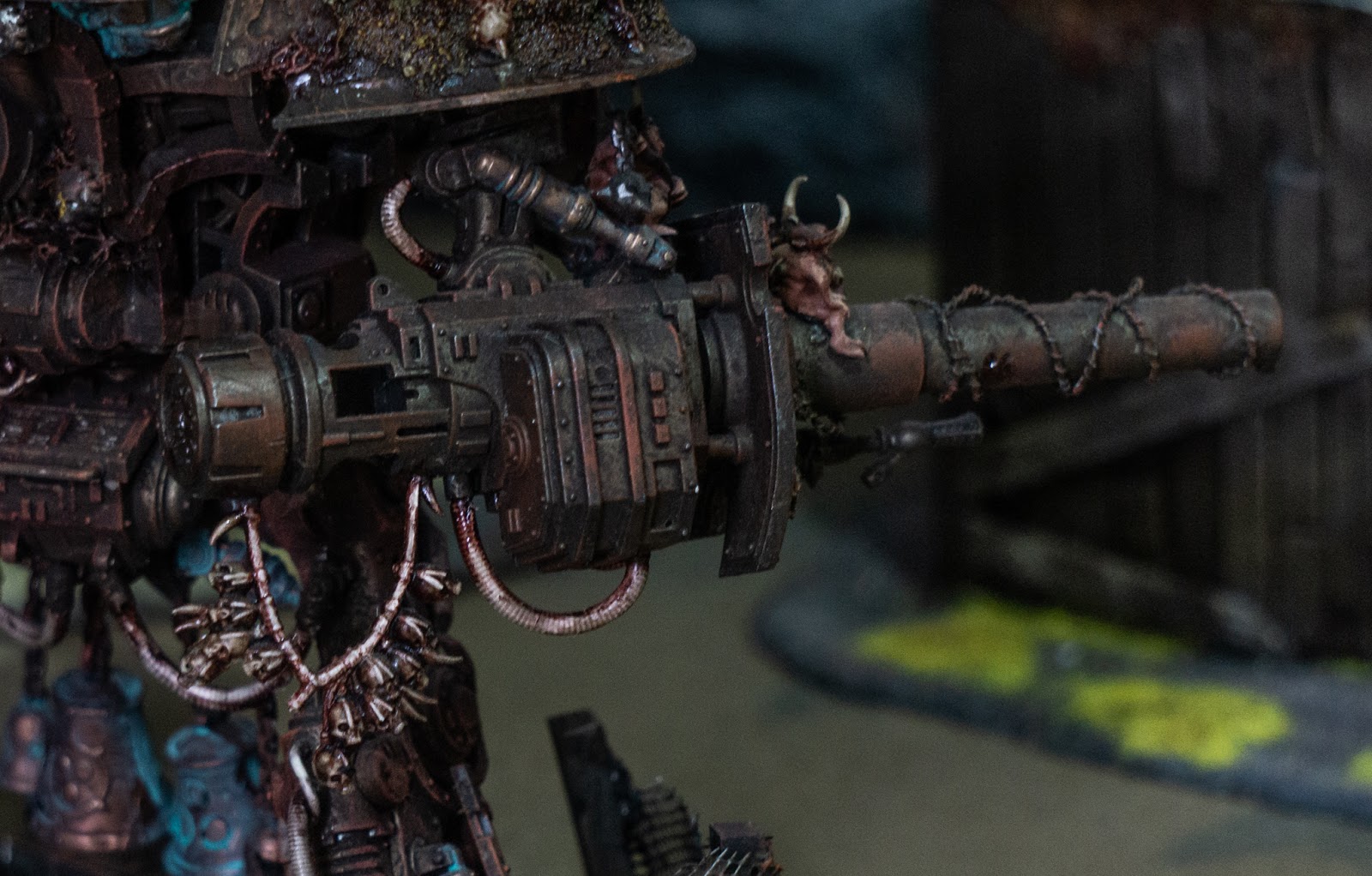
The model was an Ebay rescue, so I had to use the Thunderstrike Gauntlet. I had the idea that maybe I could replace the fingers with scythes for the whole 'reaper' aspect of Nurgle. I cut the fingers at the first joint and used spare scythes and Rot Fly claws to create talons. I was pretty happy with it. For the cannon arm, nothing immediate came to mind, so I went rummaging through my bit boxes. The string of skulls hanging from it was a spare part from a Beastmen Ghorgon, and I thought that it would be fun to have a couple of Nurglings riding on it.
A few skulls added in the Nurgle icon sysmbol was enough to make the cannon seem alright to me. I added a bit of UHU in the barrell gave the impression of oil drooling out. After some thought, I added a spiral of model barbed wire. If I recall correctly, it was because I was starting to think of the head as a World War 1 gas mask and so I thought I'd lean to a sort of nightmare trench warfare feel.
Of course, I then got distracted by something else and put the Knight down for a couple of months. When I went back to it, I couldn't quite remember my previous ideas. The fleshy growths on the back of the hull were added because... well, because that's one of my favourite Nurgle gimmicks. I then did something really dumb I'd found some bits from a Chaos Warshrine and added them to the shoulder pads. It looked kind of rubbish, so I decided to fill in the gaps with glue and sand. It looked worse.
I arrayed the sub-assemblies of my Knight... and got bored again. I couldn't figure out its identity. I lost interest again for a while.
A couple of weeks ago, I kind of flipped. This had been sitting about too long, and even if I couldn't figure out what the central theme was, it was getting finished. Then it occurred to me: what if its theme was that it was exactly what I had made it? A derelict, abandoned on a world after a disastrous campaign, rusting slowly away as its machine spirit goes insane for lack of purpose. Eventually, the monster lurches into unwholesome motion, an aimless and wandering monster with no true identity except resentment, until it ultimatey falls in with more of its own kind.
I added a plague spewer in plague of a meltagun. For the carapace, I added various horns and tusks, as well as the brazier from a Lord of Contagion. I finished the body with a Nurgling from Mortarion riding on top.
For the base, I decided to go with an abandoned goods yard - I imagine the Derelict Paragon lumbering with dragging footsteps through a desolate, empty world of rusting fences and forgotten cargo. As well as the boxes, barrells and crumbling fence, I added a Sludge Grub for a sense that the vermin have taken over this world. The Nurgling sitting on the barrel is from the Space Marines Heroes series.
Ultimately, I'm happy with him because I made so many mistakes and was so ill-dsicplined, but he Looks pretty decent in the end!
Labels:
Chaos,
Chaos Knight,
Conversion,
Death Guard,
Imperial Knight,
Nurgle,
Warhammer 40k
Saturday, 22 February 2020
High Elves - a Dream of Hope
The High Elves of Ulthuan have lost much, yet their is a strange optimistim among them. The shadow of the oncoming Rhana Dandra which has hung over the Asur for centuries has lifted. It's a new age filled with possibilites/ Which probably a good thing for Teclis, who still can't quite believe that he's now the Phoenix King...Read A Dream of Hope.
Labels:
Age of Rebuilding,
Conversion,
High Elves,
Warhammer Fantasy
Saturday, 1 February 2020
Magos Mestobargos and the Corpsefeeder
A devotee of the Arch-Heretek Belisarius Cawl, Magos Mestobargos is fascinated with the union between flesh and steel, particularly in the ways that discarded and mutilated components may be welded into new and horrific creations. One of his greatest triumphs is the Corpsefeeder, a monstrous daemonic war machine which stalks the battlefield collecting the remnants of enemy soldiers and ruined machines, to be later reborn into a horrific second life...
That's basically the recipe, along with a bucketload of filling and pins! Not sure what I'll use him for in games. I might use him as a Plague Hulk, or write some custom rules for him (I play with narrative gamers). I should find reasons to pair him up with his conceptual brother the Blightstalker, who was my first version of this idea.
This conversion came about more or less because I had buckets of bits left over from other conversions. The central trunk was a tattered old Forgefiend which had leant bits to the Headsman and the Spiderfiler among other bits. The Maggoth kit comes with a couple of sets of arms, and that was where the legs came from. They had to be cut and pinned into place.
The tentacles (which I imagine it uses to forage for bodies and components) are spares from a Dark Eldar Talos (which reminds me that I need to photograph my Dark Eldar sometime). The horns jutting out of its head (?) are spares from a Great Unclean One.
The tail was the swan-off leftover from the Blight Hauler I used to build the head of the Hanging Tree. I tidied it up a bit and pinned it in place, then built up the flesh around it with PVA/Kitchen towel mix and then green stuff.
Mestobargos himself and his weird throne wossname is based on half of a Vampire Counts Mortis Engine which I got second hand. I'd already used a good portion of it for throne of Lord Eiterfex, but a bit of side by side comparison showed that it would sit nicely on the Corpsefeeder's back. The throne back with the evil webbing is a leftover bit from the Ararchnarok which the previously mentioned Spiderfiler is based on. For the magos himself, I used Belisarius Cawl's axe (if you look at the link at the top you'll see that I replaced Cawl's with a Lord of Contagion's axe). The head is the alternate head from the Magos Dominus I used to Build Magos Langyll. His extra arms are cabling from the tatty Forgefiend and the hands are spare zombie and ghoul hands, which I seem to always have more of.
That's basically the recipe, along with a bucketload of filling and pins! Not sure what I'll use him for in games. I might use him as a Plague Hulk, or write some custom rules for him (I play with narrative gamers). I should find reasons to pair him up with his conceptual brother the Blightstalker, who was my first version of this idea.
... what's less clear is how I'm going to store him!
Labels:
Chaos,
Conversion,
Dark Mechanicus,
Death Guard,
Nurgle,
Warhammer 40k
Subscribe to:
Posts (Atom)