Tuesday, 22 October 2019

Refitting Beastmen Part 1: the Beastlord


Beastmen have always been my favourite flavour of Chaos in Warhammer Fantasy: there's something very evocative about herds of giant evil murder-goats loitering in the forests, an odd fusion of Visigoth and faerie tale monster. They're the thing that goes bump in the night. They're the monster that ate grandma.


But Games Workshop never seemed to quite get behind the idea. We're not talking about the same sort of self-inflicted problem as Chaos Dwarfs, but their efforts with Beastmen always seemed a bit half-hearted. The 2003 Beasts of Chaos release, for example, featured only one plastic kit and the importing of several 90s kits (this is in the same era as Bretonnians getting four plastic kits, Wood Elves getting three and Ogre Kingdoms getting four). One of the bigger problems for the Cloven Ones was the lack of variety in Beastlords. There was two released in 2003. Both were nice enough models, but they had problems. The great weapon wielding one was a one-piece casting in metal which made him almost conversion-proof, and the other had two separate axes but basically no way to customise him. Added to this, neither one of them was as imposing as we might like.


This was a problem which was unexpectedly solved when Games Workshop released its recent Beastgrave game. One of the factions was the muddled mess of conflicting identities and reused CAD that you'd expect from an AoS original concept, but the Beastmen were very much in the spirit of the Old World. What's more, the Bestigor was large enough to stand out as a leader in a Beastmen army. And look how freakishly well he stands on a 25mm square base!

So there it was: finally, a Beastlord worthy of the name. And that was just the start of my quest to bring the Beastmen into the modern age...


Saturday, 14 September 2019

The Dwarfs return

No race suffered such brutal beatings as the dwarfs during the dark years. But the dawi are a hardy race, and they have returned to take vengeance on their enemies... and take back their ancient homes.

Read about the return of the dwarfs

Friday, 30 August 2019

The Imperium is a really weird place


The Imperium of Man is... really strange. I think it's one of the things which makes it so powerful and appealing. You have this bizarrely futuristic, medieval universe where theology and genetics are all mixed up together. One of the aspects which has always appealed to me the most in this bizarre landscape of oddities is the population carrying on their business. There's an aspect of body horror and existential fear to Imperial citizens, with augmetic tools of their profession sometimes grafted right onto their bodies, but I think that the humanity of these everyday folk is really quite charming. One of the silliest things about an overwhelmingly silly era of 40k lore is the ludicrous assertion that the Imperium's million worlds are ALLLLLLL at war. One of the things I always found so appealing about the Imperium in past years was that most Imperial citizens live reasonably peaceful lives: the Imperium, for all of its thousands of wars, is proportionally much more peaceful than our turbulent modern world. This meant that there were always people going about their peculiar everyday lives, worried less about the xenos and more about job security or being liked or being able to go on holiday this year.


These two characters are among my favourite for exemplifying the bizarre diversity and strangeness of the Imperial citizenry. The models are both Inquisitorial acolytes, neither are combatants, so I like to imagine them as people in everyday life. I don't think either is a servitor despite their augmentations: the chap with the unwinding scrolls has a robe and accouterments rather too ornate for the Imperium's lobotomized slave class. Instead, I see both men as some kind of ancillary Administratum functionary.


The more heavyset man I think of as an archivist: the augmetic speak grille allows him to replay audio files on request, and the great rolls of parchment are for printing out dataslates when necessary. I imagine that he spends the majority of his time cataloging, tagging, and filing data. That it might be pointless data never occurs to this bloke: all data is important as far as he's concerned. When a colleague comes to him with a request for a file to be recalled and printed, he thoroughly examines their ID and makes a record even if he knows them well. He does this not to be a bore but because the data of how and when the data was accessed is in itself no less vital than the records themselves. Maybe, if we take the model's original purpose into account, that's why he ended up with an Inquisitor: someone was making very suspicious requests which, when he reported them, helped the Inquisitor to crack open a monstrous heretical plot.


The other character I see as a notary. His augmetics were offered to him to heighten an already formidable accuracy and attention to detail which made him stand out from the other Administratum clerks in his division. A fastidious man, he accepted the upgrades. In meetings of senior Imperial personnel, the notary stands in the corner, his hands a blur as he takes down in cyphered shorthand, not just the words spoken but the relative positions, body language, and tone of the speakers. When not in meetings, he faithfully translates an exacting report of the events without bias or prejudice. Outside of his working hours, the notary spends most evenings in a small but clean and well-ordered hab. He enjoys reading histories and books of science.


And that's the great thing about the stranger characters in 40k, whether they be models of art pieces - you can well imagine history and personality for them!


Thursday, 22 August 2019

Command of the finer points

Maybe it's because I'm a dedicated narrative player, but I have a bad habit of forgetting my Command Points or losing count of them. My group got around this by lining up a bunch of dice beside the board to represent them, but it wasn't very nice to look at. I decided I should make some counters to keep track of them.


I had a bunch of Necromunda bases knocking about. Maybe it's my age but I kind of feel like pre-textured bases aren't as much fun, so I'd based the models on normal bases so I could do my own texturing.


I had the idea of some sort of industrial or mechanical surface slowly being devoured by some creeping parasitic daemon fungus. First up, I glued trios of polypropylene spheres (small plastic balls) onto the bases to form the symbol of Nurgle. Once these were dry, I built up a little tumourous flesh with PVA and tissue. The groping vines/tentacles are Woodland Scenics Autumn Foliage glued down with great fury.


And there you have it! Quick, simple but fairly effective!

Monday, 29 July 2019

For whom the bell tolls


It occurred to me that I've never shared photos of this guy despite him being the second Death Guard model I ever actually painted. He's actually one of the models which tempted me back to 40k in mid-2017. I liked that he was something other than a guy cuddling a gun. There was a peculiarly entertaining lack of heroism about the glum bell-wielder. I didn't know at the time that the Blightbringer would be among the first of the many bizarre and intriguing models other than glorious combatants looking all heroic and stuff.


He was also the first model who got the Synod of Suffering paint scheme in something like its final form. In my first attempt, it was more or less the same but the cloth was painted as ragged human skin. It looked a bit silly, to be honest. As you might have noticed if you've seen my work, one of my primary inspirations for my Nurgle is the idea of the slow dilapidation and corrosion of the manmade. This is because these are things which make me uneasy and spooked. I remember once when I was out walking, I came across what looked like an abandoned production facility of some sort, with crumbling sheds and a larger, maudlin building. And here's the thing: I've sat by myself high in the Alps, nobody for miles, only the wind sighing, and felt no sense of desolation. But in that corroded echo of human ambition, I felt unnerved, as if unseen presences were watching me from the dark, disintegrating buildings.


To bring this back to the cloth on Plague Marines, I decided to work in a way which would first create a simplistic version of the 'uncorrupted' colour scheme and then smear on the grime. I chose white as the colour for the cloth partly because of the implication of purity (and subsequent defilement) associated with that colour, and partly because the gross stains would be easiest to apply over white! I liked the effect, and thus my new army started in earnest.


Sunday, 28 July 2019

The hope of spring


This is a strange era for the Wood Elves. The King and Queen who have ruled them for centuries are gone. Now there is a new King and Queen in the Woods... can they live up to their mighty forebears?


Friday, 26 July 2019

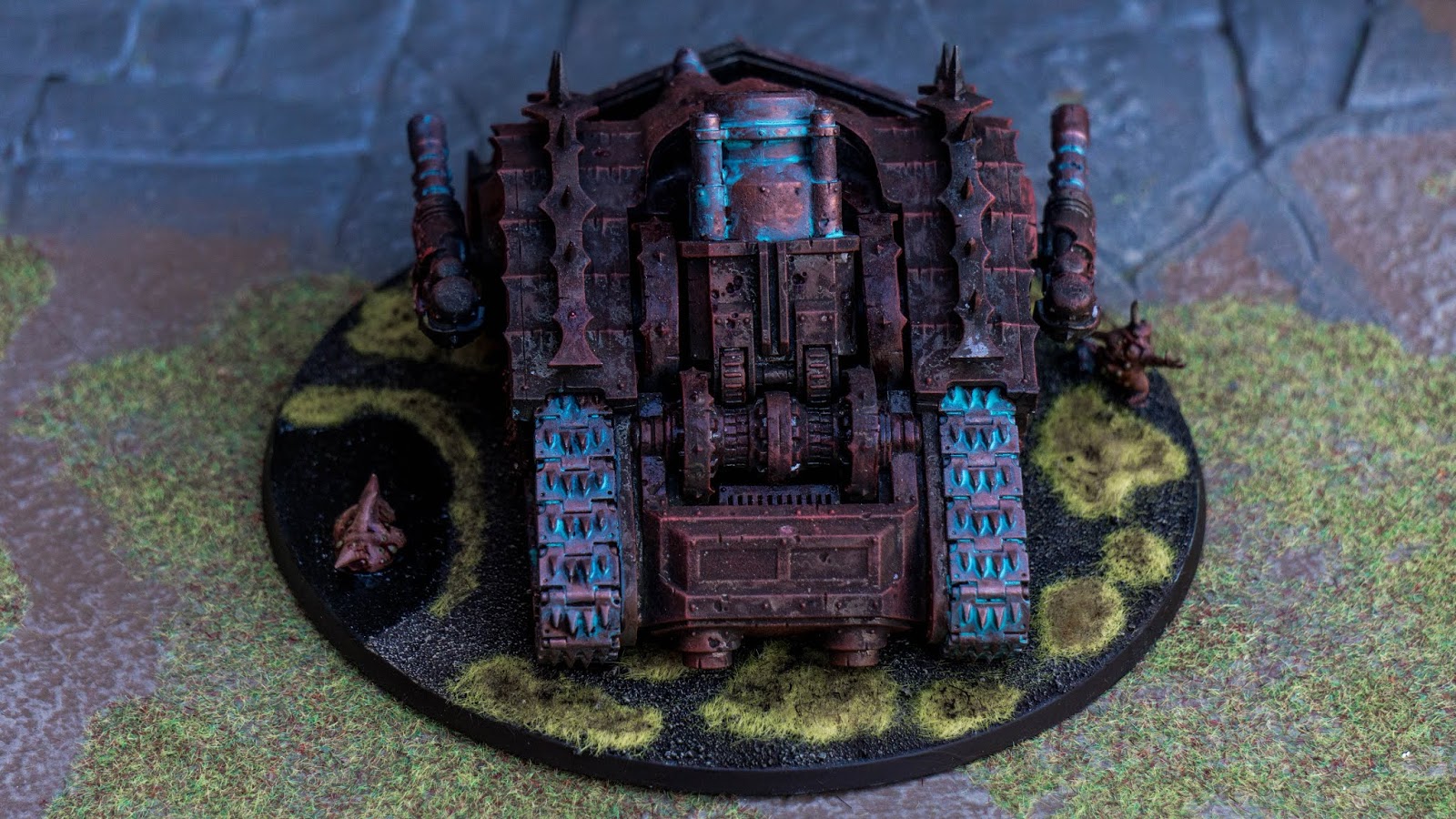
Plagueburst Crawlers


 Anyone else notice that we’re moving backwards?”
The tone of Lord Eiterfex’s voice was light, but Belisarius Cawl knew that tone. The Lord of Suffering was, in his slow and inexorable way, getting angry. Cawl didn’t blame him: The Imperium had done a good job of making Saxon Decimus Ultimus formidable: the hive city’s walls were encrusted in weapons batteries, and landing strips high in the city’s upper flanks were spitting out flights of fighters and bombers which were creating a miserable attrition rate among the Airborne Pestilence. Seeing Hytothrax the Younger being humbled probably amused Eiterfex, but not enough to compensate for the fact that the advance had stalled. The Imperium had been ruthlessly efficient in leveling six kilometres of the outer city and shanty towns around the hive, so that by the time the Death Guard arrived there was an almost impenetrable barrier. Even here, a kilometre from that killing field, enemy munitions tumbled past periodically.


Finis Omnium lumbered past, heading back into the relative safety of the wider urban sprawl. The ancient Reaver Titan was dragging its left leg a little, and the wet spark of faltering void shields gave the air an unpleasant, electric edge.
Eiterfex watched the titan with an air of faint interest. Cawl barely dared to breathe.


"You know, he's broken the backs of six worlds. Six. Credit to the Throne-rats. They've bloodied our noses good and hard."
The light quality in Eiterfex's voice had become even more pronounced. None dared approach him for a moment. Eventually, it was Sergeant Thrombax who spoke.
"Let's be real about this, boss. We screwed up going after the lesser cities first." 
There was another long, dangerous pause before Eiterfex grunted. 
"Oh well," he replied, "it was a gamble. We lost this one."
He stared into the distance.


"Alright," he said eventually, "pull back. That goes for Doomhark and that upstart Hytothrax. All divisions move back to the second city."
Thrombax nodded and wandered off, bellowing orders. 
"Cawl," said Eiterfex after a moment, "get your Crawlers ready. The Throne-rats will see us pull back. They won't be stupid enough to fall for it. But they will attempt to secure the outer urban sprawl. The Brass Reapers are only days out now, so they won't want to take any chances. They think the end is in sight. And it is in the hopeful nature of these poor creatures that their downfall always comes.
"I think we let them have back that ground we just took."
Eiterfex chuckled. It was a whispery, dry thing. 
"And then, Cawl... we shall rain down horrors upon them."