Despite his frightening appearance, Doktor Clademann is a very kind and compassionate man. A gifted expert in pathogens and virology, Clademann travels to plague-ridden worlds with Imperial relief efforts and works with unusual intensity to save ailing citizens. Over the years, Clademann has developed a bitter enmity towards the Plague God Nurgle. Although not primarily a fighter, Doktor Clademann has become a persistent irritant to Lord Eiterfex. Whether this will shorten his career remains to be seen...
I wanted this character to look really ghoulish, whilst being a nice man. The oddity of 40k: men who look like monsters but are heroes. I started with the Cairn Wraith, because that's where most conversions seem to. I sawed a plague-doktor-esque head from a chaos cultist and trimmed it down. With a bit of fiddling, this fitted nicely into his cowl.
The left arm was made from a Magos Dominus arm and a Skaven clanrat's big kitchen knife. This made a reasonably nice bonesaw. The right arm was a similar piece, made with the hand from a Dark Eldar Haemonculus.
The trunk of his body was a random Adeptus Mechanicus component trimmed down to fit. His reaching mechadendrite with the claw, the pack hanging from his back and the funky bionics on his back are all from a Tech Priest Dominus. The other mechadendrite is the majority o a servo skull (the Scions one I think). I added the censer from the servo skull to his back, the idea being that it constantly burns holy incense in diseased places to alleviate suffering and ward of spiritual malaise.
The piece was finished by the long, curling mechadendrite he's balanced on, which is also from the Haemonculus. I then put a purity seal on just to remind people that he's Imperial, and he was good to go!
Showing posts with label Adeptus Mechanicus. Show all posts
Thursday, 21 June 2018
Tuesday, 3 April 2018
Let's forge a narrative part 2
Part 1 of my story was well received, so here's part 2. Will Belisarius Cawl and Master Pustolion be able to carry their diabolical plan, or will Inquisitor Horn be able to foil them?
Thursday, 29 March 2018
Knight fever
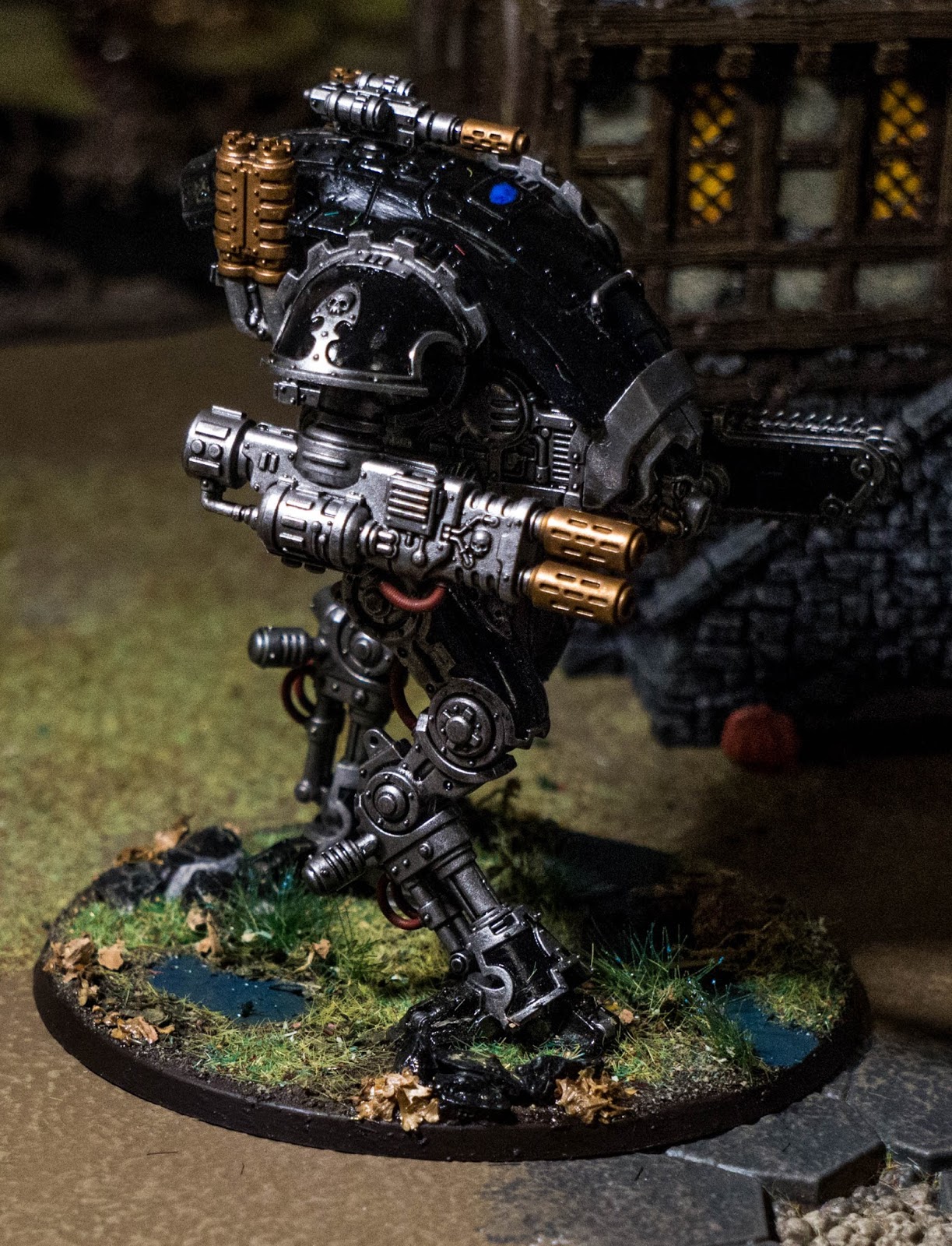
I do rather like the new Knight Armiger. I like all Knights, as long as they're in plastic and not a tricksy Forgeworld kit made of resin that will warp when you look at it! I'm very pleased that the Knights are being expanded. Knight Armigers, of course, are a big part of that.
I like that their general outline an conception seems to be a nod to the older Epic Knights, or the Knights described in Graham McNeill's Mechanicum.
I didn't the model, but I did want to have a word about the base. This is a nice, soli model with very little space used up on the bae - a perfect opportunity to muck about with a bit of literal world-building. A nice base can really help a model to tell a story.
People who have seen my projects before will know that my collection often seems to suggest that my brain is the location of a triple threat match between John Blanche, H P Lovecraft and David Cronenberg, so for this I wanted to do something a little different, something which channels my WFB roots.
First up was the base. Creating the brook and the pool were dead easy: apply PVA to the base everywhere that you don't want the water to be, and add your sand. When that's done, apply another layer of PVA to the water areas, just to slightly smooth the dimples you'll get on Citadel bases. Then paint and drybrush your base as normal.
Now, the forest floor type base looks like I've done something clever, but I haven't. The key here is to just cast about for different basing materials. the rocks are just small lumps of washed slate. Those long flowers you can see down by the water are from strips of model rail flowers. Similarly, the foliage is a mixture of static grass, flock, leaf mulch and forest scatter available from vendors like War World Scenics. These sort of products can produce a wide range of effects and are significantly cheaper than GW might have prepared us for!
I like that their general outline an conception seems to be a nod to the older Epic Knights, or the Knights described in Graham McNeill's Mechanicum.
I didn't the model, but I did want to have a word about the base. This is a nice, soli model with very little space used up on the bae - a perfect opportunity to muck about with a bit of literal world-building. A nice base can really help a model to tell a story.
People who have seen my projects before will know that my collection often seems to suggest that my brain is the location of a triple threat match between John Blanche, H P Lovecraft and David Cronenberg, so for this I wanted to do something a little different, something which channels my WFB roots.
First up was the base. Creating the brook and the pool were dead easy: apply PVA to the base everywhere that you don't want the water to be, and add your sand. When that's done, apply another layer of PVA to the water areas, just to slightly smooth the dimples you'll get on Citadel bases. Then paint and drybrush your base as normal.
Now, the forest floor type base looks like I've done something clever, but I haven't. The key here is to just cast about for different basing materials. the rocks are just small lumps of washed slate. Those long flowers you can see down by the water are from strips of model rail flowers. Similarly, the foliage is a mixture of static grass, flock, leaf mulch and forest scatter available from vendors like War World Scenics. These sort of products can produce a wide range of effects and are significantly cheaper than GW might have prepared us for!
Tuesday, 27 February 2018
Magos Langyll, the Innovator of Rust
When Belisarius Cawl fell to Chaos, he did not go alone into damnation. Whole macro-maniples of Skitarii and other Mechanicus warriors fell. Quickest to embrace the power of Nurgle was Ingogen Langyll, Cawl's right hand man.
Cawl himself may be given some meagre credit inasmuch as his intent may have been noble in the beginning. His monstrous Primaris experiments, his blasphemous plans to capture the Eye of Terror and the lunacy of even suggesting he could resurrect a primarch were at least originally intended as plans to help the Imperium.
No such doubts exist with Langyll. Where Cawl had raged at the perceived blindness of the Imperium and its condemnations, Langyll was dismissive and without regret turned his attention to the saving of his various materials and experiments.
Cawl himself may be given some meagre credit inasmuch as his intent may have been noble in the beginning. His monstrous Primaris experiments, his blasphemous plans to capture the Eye of Terror and the lunacy of even suggesting he could resurrect a primarch were at least originally intended as plans to help the Imperium.
No such doubts exist with Langyll. Where Cawl had raged at the perceived blindness of the Imperium and its condemnations, Langyll was dismissive and without regret turned his attention to the saving of his various materials and experiments.
Langyll had been carrying out highly unethical experiments for centuries. He sought ways to marry flesh, machine and the power of the warp in new and bold ways. The man had no loyalty, no humanity and no real allegiance beyond a commitment to the pursuit of knowledge. What a man of this disposition might yet achieve in the dungeons of the Plague Planet remain to be seen.
Langyll embraced the power of Nurgle completely and without any sign of regret, quickly becoming fascinated with the seeming contradiction of his new patron's focus on decay and resilience. Motivated by this morbid fascination, Langyll has begun to experiment once more, and in deep dungeons of screams an despair, strange shapes lurch into unclean life...
Labels:
8th ed 40k,
Adeptus Mechanicus,
Chaos,
Dark Mechanicus,
Hellwright,
Magos,
Nurgle
Monday, 29 January 2018
Belisarius Cawl, Arch-heretek, Hellwright of the Plague Planet
In late 973.M41, the Ordo Hereticus began to ask quiet, sensitive questions about the conduct of a high ranking Martian Archmagos named Belisarius Cawl. The task of leading this investigation fell to an Inquisitor named Erasmus Horn. Horn was know for his subtlety, patience and most of all for operating away from the hierarchy of the Ordos. This was important for the Inquisition, because the investigation required plausible deniability. Horn knew and accepted that should he be discovered at the wrong time, his masters would disavow him.
The reason for this secrecy was that Cawl ranked among the most senior and revered Archmagi of the Adeptus Mechanicus, second only to the Fabricator General himself. Should the case against him fall through, a monstrous diplomatic incident might well be the result. But the rumours were too alarming to leave unexamined. There were mutterings, whispered gossip that the Archmagos was heretically tampering with the Emperor's divine work, that he had indulged in the use of warp technology in a lunatic quest to improve on that which is holy and right.
Working with sympathetic magi inside the Martian hierarchy, Horn was able to determine that Cawl had for some time been making requisitions which, though individually innocuous for a senior Archmagos, painted an alarming picture when put together. Cawl had been obtaining suspicious amounts of Astartes geneseed, vastly more than was warranted for purity checks. Cawl had been careful to source through a number of different channels. He was clearly trying to avoid attention. On top of this, he seemed to have over several years acquired an alarming amount of cloning and genetic manipulation facilities. It was agreed between Inquisition and Mechanicus that this evidence warranted a raid on Cawl's Martian holdings.
A significant taskforce of Skitarii and Inquisitorial Stormtroopers assaults Cawl's forges, and after a brief ferocious battle was successful in neutralising Cawl's forces. It was quickly apparent that this was because Cawl himself and a portion of his forces were not present: either the Archmagos had been away on business or had got wind of the investigation. However, whilst Cawl himself had slipped through their fingers, what Inquisitor Horn and his Mechanicus colleagues discovered was enough to damn the Archmagos a hundred times over.
Whatever doubts there had been about Belisarius Cawl, they were all confirmed in that monstrous exploration of his laboratories. That Cawl was wholly insane there could no longer be any doubt. In his blasphemy, he had declared himself greater than the Omnissiah, claiming that he could better the work of the Emperor. The appalled investigators found hellish attempts to create a bigger, more pliable form of Astartes. In his arrogance, the vanished Cawl had labelled the abominations Primaris, a word which contextually has overtones of supremacy which mp proud Space Marine chapter would have ever recognised. Thankfully, Cawl's experiments had been largely unsuccessful: such warp-twisted abominations that were found in the laboratories were few and far between. Horn put them to the flame without exception.
Further exploration of Cawl's holdings showed more heresies. An unfinished device was discovered the purported reason for which was to expand the Eye of Terror into a morbid scar across the galaxy. Every senior Archmagos consulted by Horn dismissed the device as a madman's fevered experiments. Yet the hellish purpose behind them was in itself enough to condemn any servant of the Omnissiah. Cawl apparently planned to use this fiendish warp-scar as a power source. His journals detailed insane plans to justify his actions by claiming that they came straight from Roboute Guilliman. Indeed, it was clear that he intended to create a cloned puppet of the thirteenth primarch to be his mouthpiece. All of Cawl's work was put to the sword and the purifying flame. He was expelled from the Adeptus Mechanicus and declared Excommunicate Traitoris in a unanimous vote by the Senatorum Imperialis itself. Cawl, however, had disappeared.
It would be many years before Belisarius Cawl came forth again to blight the Imperium. Realising that he was discovered, the Archmagos had fled from Mars. Initially, his plan had been to travel to a secret facility he maintained in the Ghoul Stars. However, on his way, his ship was ambushed by a fleet belonging to the Synod of Suffering. The Archmagos was dragged before Lord Eiterfex, who offered Cawl a choice between service and death. To Eiterfex's amazement, Cawl agreed immediately. His bitterness and despair at the failure of his schemes had driven him further into the spiral of madness, and the degraded glory of Nurgle now appealed to him immensely.
Granted laboratories on the Plague Planet, Cawl set to work with deranged abandon. If the Emperor refused his genius and rejected his superior Astartes, then Mortarion and Eiterfex would reap the reward. In deep caverns that rang to screams and scrapcode, Belisarius Cawl found his true vocation. Great adominations of flesh, metal and Neverborn energy staggered from his putrid furnaces.
By 015.M42, Cawl was ready. And at Lord Eiterfex's side, he marched out to take his revenge on the galaxy.
Subscribe to:
Posts (Atom)